Multimaterial Pliers

Description
In this project, I created pliers using two materials. This project involves print-in-place parts, which are parts that work right after printing with multiple components. In this case, after printing the pliers together, they will simply work. One notable application of print-in-place parts is with robotics and mechanical engineering. Engineers and hobbyists utilize this technology to create robotic components, such as joints, gears, and linkages, that can be printed directly into their assembled state. This eliminates the need for time-consuming assembly processes and reduces the risk of misalignment or errors that may occur when joining multiple components. Additionally, print-in-place parts enable the creation of compact and lightweight robotic systems, making them ideal for applications in fields such as prosthetics and automation. Another application area is in the development of intricate puzzles and toys, where print-in-place mechanisms can be integrated to enhance the interactive and engaging aspects of the final product. From Rubik’s cubes to mechanical puzzles, 3D printing allows for the creation of complex and customizable designs that challenge and entertain users. Additionally, in education, print-in-place parts offer valuable opportunities for hands-on learning and experimentation, allowing students to explore mechanical principles and design concepts in a tangible and interactive way. Overall, print-in-place parts represent a fascinating intersection of creativity, functionality, and manufacturing innovation, with diverse applications across various industries and disciplines.
When considering material combinations for print-in-place parts, several options can enhance the printing process and the structural integrity of the final product. These combinations encompass various materials such as PLA and TPU, PLA and PVA for water-soluble supports, ABS and HIPs, and the utilization of fresh and recycled materials. The bonding between these materials hinges on several crucial factors. Surface energy plays a pivotal role, as materials with similar surface energies tend to bond more effectively. Chemical composition also influences bonding; materials with akin intermolecular forces generally exhibit better bonding tendencies. Disparities in shrinkage and cooling rates between materials can lead to issues such as warping, distortion, or even layer separation. Furthermore, the mechanical compatibility between materials is essential; instances where materials possess mismatched mechanical properties, such as combining flexible and rigid materials, may result in ineffective bonding and compromised structural integrity.
Model
About
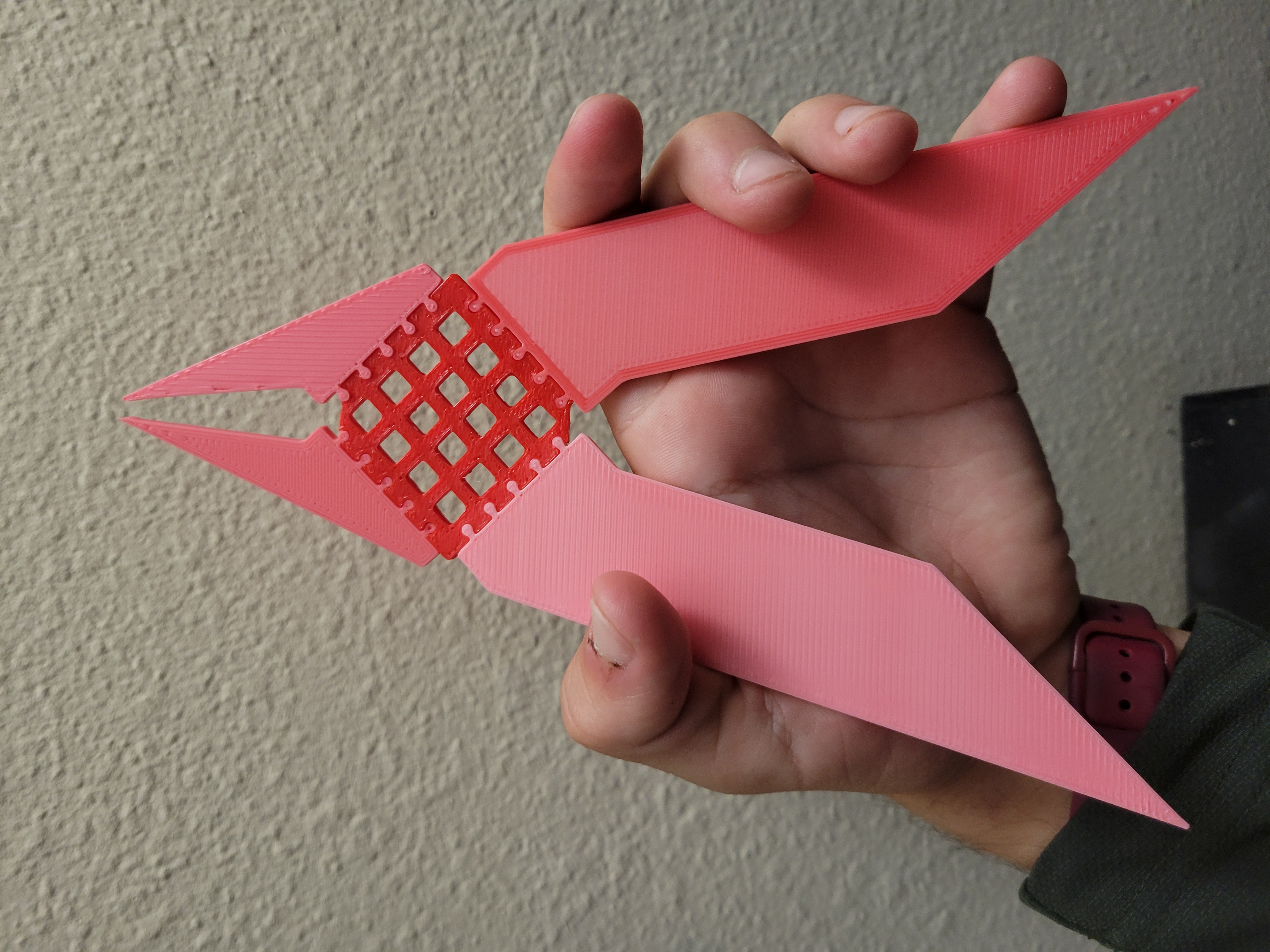
I based most of my design on an online model. The model uses a flexible grid in the middle connected to 2 handle pieces and 2 jaws. As the handles get squeezed toward each other, the middle portion flexes which causes the jaws to move towards each other. To connect the middle part to the handles and jaws, I created a joint similar to the online design with its circular joint design. In this model’s joints, the circular part will fit into a hole similar to a puzzle piece to stay in. To print the pliers, I used PLA and TPU. I used the PLA as the rigid material for the handles and jaws. I used TPU for the flexible middle portion of the pliers. I printed each part separately and then pushed them together to create the final product.
Specifications
Jaw Length: 40 mm
Jaw Capacity: 5 mm
Print settings
PLA:
Nozzle Diameter: 0.6 mm
Infill: 20%
TPU:
Nozzle Diameter: 0.6 mm
Infill: 20%
Exaple Usage
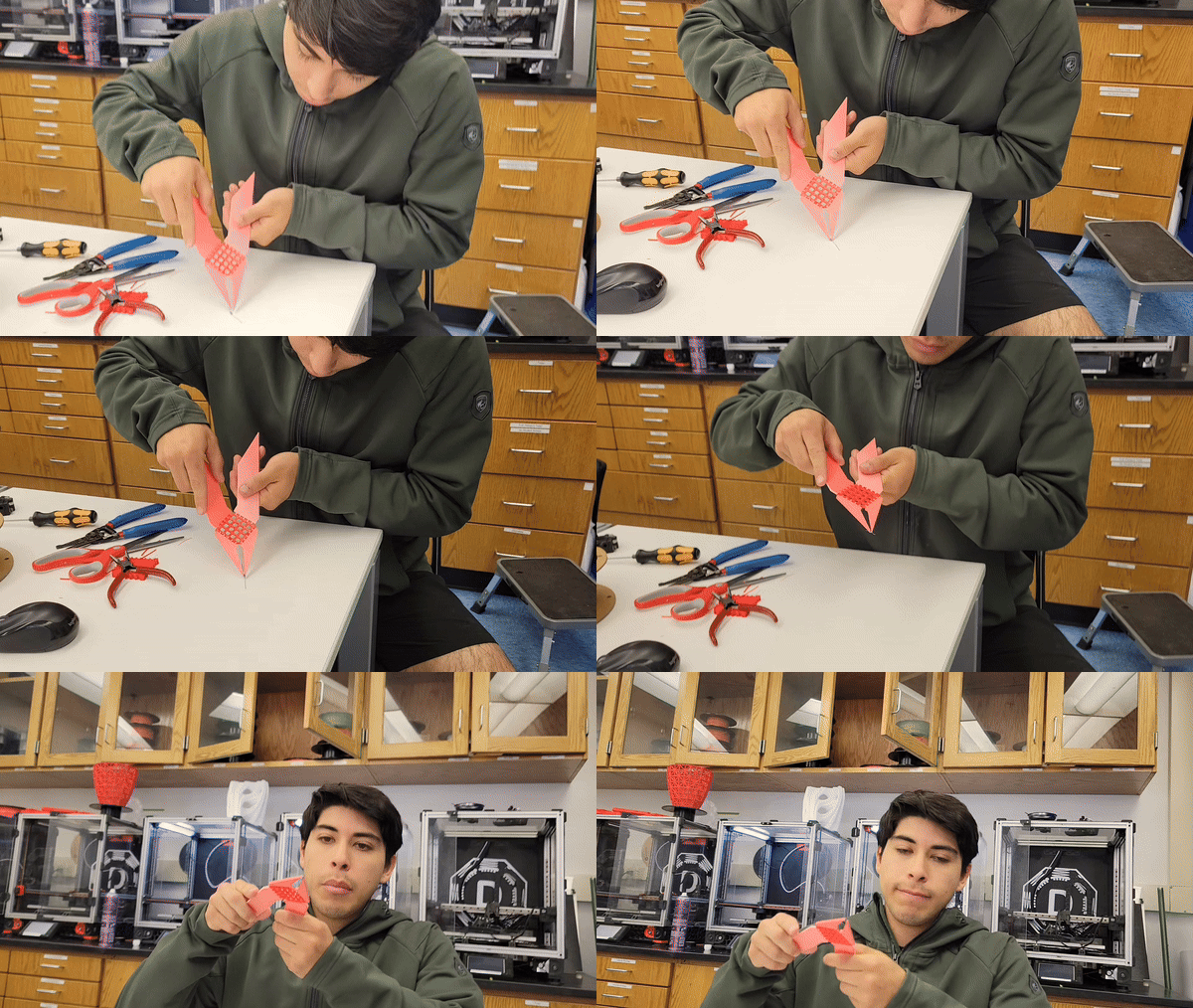
*Only 1 printed iteration created